Meth Rules for NZ Rental Properties
A plain-English guide to the current NZ rental property meth rules, including testing, contamination thresholds, decontamination, and what the rules mean in practice.
Official regulation: Residential Tenancies (Managing Methamphetamine Contamination) Regulations 2026
This page is a plain-English overview only. It is not legal advice.
The 2026 meth contamination regulations apply to residential tenancies covered by the Residential Tenancies Act 1986. Not every rental or living arrangement falls under that Act. Where the Act does not apply, NZS 8510:2017 may still remain relevant as the technical standard, but the tenancy-specific regulatory pathway may not apply in the same way.
The New 2026 Meth Regulations, Tenancy Services & Useful Links
Use these links to access the key official references, understand the 2026 methamphetamine framework, check the relevant standard, and move to the most appropriate next pathway — whether that is meth testing, baseline assessment, decontamination, pre-purchase quote support, or practical property advice.
Official Meth Rules & Reference Sources
- Residential Tenancies Meth Regulations 2026 — NZ LegislationThe official 2026 rental-property methamphetamine framework.
- Tenancy Services — Meth and rental propertiesGovernment guidance for managing meth in rental properties.
- NZS 8510:2017 — Standards New ZealandThe standard for testing and decontaminating properties.
Meth Testing & Baseline Assessment Pathways
- New 2026 Meth RegulationsA clear guide to the 2026 meth rules, thresholds, and testing.
- Meth Testing ServicesPractical testing options, from DIY kits to detailed assessments.
- BaseTest — Baseline Meth TestingBaseline testing for a clear point-in-time property record.
- Meth Pre-Purchase & Property Risk QuotesPaid meth due-diligence before purchase or property decision-making.
Understand the New Meth Rules
Residential Tenancies (Managing Methamphetamine Contamination) Regulations 2026
The Basic Steps Under the New Meth Rules
A simple overview of what usually happens once a meth concern is raised.
A meth concern is raised
A meth concern may arise through tenancy issues, suspicious activity, due diligence, a prior result, or notification from Police or Council.
Initial meth screening
A valid screening assessment may be carried out using an approved method. If screening shows contamination above 15 µg/100 cm² and the landlord is aware of that result, detailed testing must be arranged.
Detailed meth testing
Detailed testing confirms contamination levels and identifies the affected rooms or areas. It must be carried out by a qualified professional who is independent of the decontamination contractor for that property.
The result determines the next step
If any room or area tests above 15 µg/100 cm², that specific room or area is contaminated and must be decontaminated. If any part of the property tests above 30 µg/100 cm², the property may be uninhabitable unless the affected part is only remote and inconsequential.
Decontamination cleaning is carried out where needed
The affected rooms or areas are decontaminated. The rules do not automatically treat the whole property as contaminated — only the specific rooms or areas above the threshold require decontamination.
The property is retested after decontamination cleaning
After decontamination, a qualified professional must carry out detailed testing again to confirm meth residue levels are no longer above 15 µg/100 cm². If they are still above that level, further decontamination and retesting are required.
Testing Explained
Screening vs. Detailed Testing
The rules use two testing steps. Screening is the first check to look for signs of meth residue. Detailed testing is the follow-up test used when the result needs to be confirmed properly and the affected rooms or areas need to be identified.
Initial Lab Meth Screening TestFirst Check for Meth
Screening means looking for early signs that meth residue may be present at or above the legal limit.
It is the first check. It is not the final room-by-room answer.
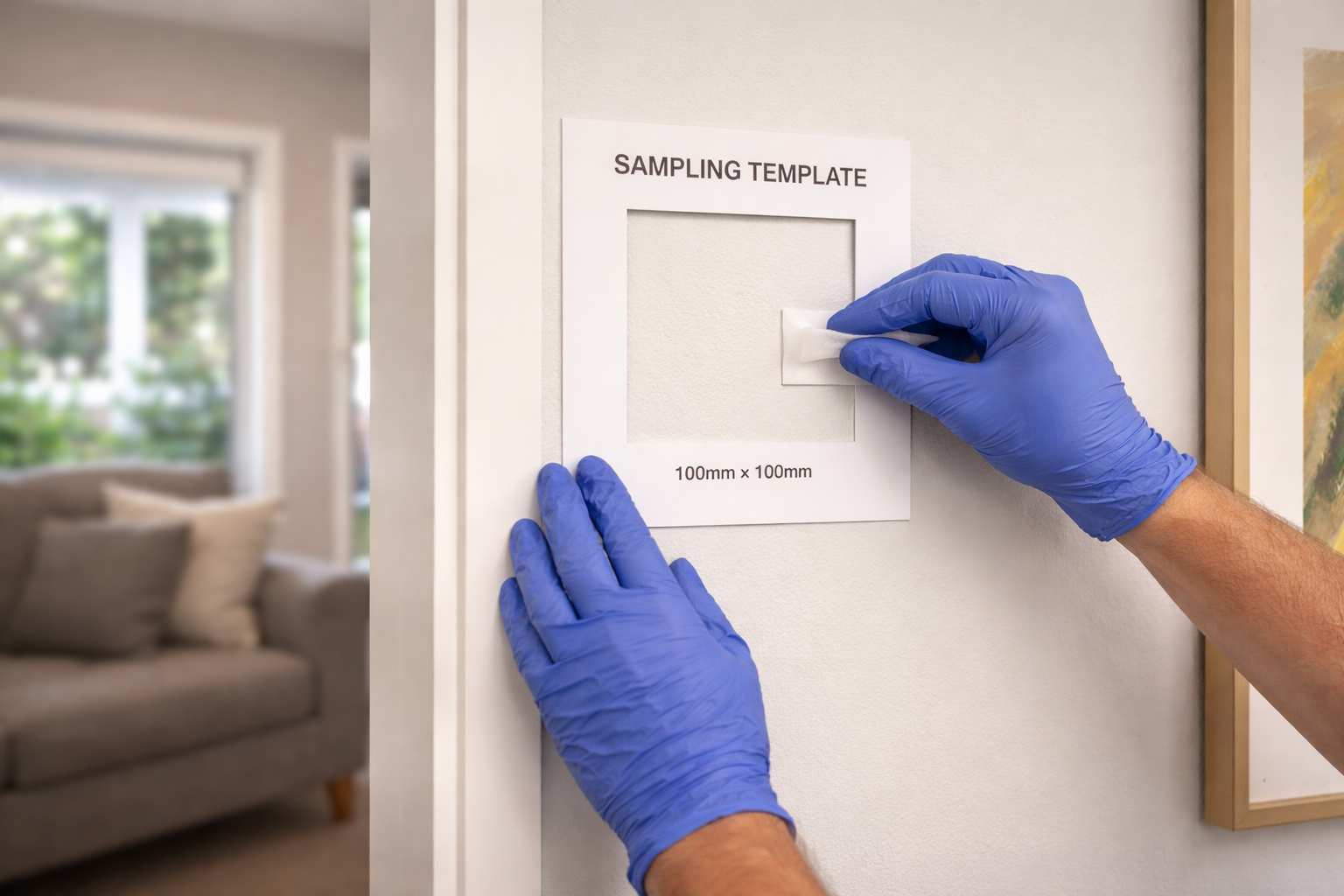
One common screening pathway is laboratory composite testing. This means several swab samples are taken from selected areas of the property and sent to a laboratory. The laboratory result gives an overall screening result for the sampled areas.
That result can help show whether meth residue may be present above the legal limit, but it does not show exactly which room or surface is affected.
- Screening can be done by any person if an approved method is used correctly. This can include a suitable DIY Lab Meth Screening Test Kit, provided the kit and process meet the approved screening requirements and the instructions are followed correctly.
- Approved screening options can include validated screening kits, individual sampling, and laboratory composite testing.
- Field composite testing is not an approved method.
- If a valid screening result shows meth above 15 µg/100 cm² and the landlord is told about it, detailed testing must be arranged.
- Screening is a warning check. It does not replace detailed room-by-room or area-by-area testing.
Detailed Lab Meth TestsRoom-by-room / Area-by-area Testing
Detailed testing is the formal follow-up test. It confirms the level of meth residue and shows which rooms or areas are affected.
- Detailed testing must be done by a qualified professional.
- The tester must be independent from the decontamination contractor for that property.
- It shows which rooms or areas are above 15 µg/100 cm².
- It also shows whether any area is above 30 µg/100 cm².
- Detailed testing helps decide what needs to be decontaminated.
- After decontamination, detailed testing is done again to confirm the affected areas are no longer above 15 µg/100 cm².
Why independence matters:The person doing detailed testing must be separate from the person or company doing the decontamination work. This helps avoid conflicts of interest and keeps the result independent.
Landlord Obligations
Full landlord obligations under the 2026 rules
The regulations are clear about what landlords must and must not do.
Must arrange testing when
- Police or a local authority notifies the landlord that meth manufacture has likely occurred at the property
- A valid screening assessment shows above 15 µg/100cm² and the landlord is aware of the result
Must not
- Rent out a property they know to be contaminated (any room or area above 15 µg)
- Enter the property without providing the correct notice required under the Residential Tenancies Act
When testing is arranged
- Provide the correct notice required under the Residential Tenancies Act before entry
- Share all test results in writing with every tenant within 7 days of receiving them
- After decontamination, arrange post-decontamination detailed testing to confirm the affected rooms or areas are no longer above 15 µg/100cm²
No requirement to
- Test between every tenancy — there is no routine testing mandate
- Treat the entire property as contaminated if only one room or area is above the threshold
- Decontaminate areas below 15 µg (though insurance may require different)
Tenant Rights & Obligations
What tenants need to know
Tenant Rights
Tenant Obligations
Where only a remote and inconsequential area exceeds the uninhabitable threshold (30 µg), the property is not automatically uninhabitable. In that case:
Insurance
Insurance & meth: what landlords need to know
The legal threshold and your insurance requirements are not always the same. Here are three key takeaways.
Thresholds and insurer requirements
Evidence and documentation
Early communication matters
Insurance note: Insurance requirements can sit alongside the legal rental-property framework, but they are not always the same. Always confirm policy-specific requirements directly with the insurer.
Old vs. New
Threshold comparison: then and now
One of the most common points of confusion is understanding which standard applies and why the thresholds differ so much.
NZS 8510:2017 is not replaced — it still governs how testing and decontamination must be carried out. The 2026 Regulations modify it by establishing new contamination threshold numbers.
Frequently Asked Questions
Frequently Asked Questions
No. There is no legal requirement for routine meth testing between tenancies. Landlords can still arrange testing if they think it is needed. A baseline test can also be a practical record where a landlord wants a clearer starting point.
Any person can carry out a valid screening assessment using an approved method correctly. However, screening is only an initial check. If the result shows contamination above 15 µg/100cm² and the landlord is aware of it, detailed testing must be arranged. The final post-decontamination result cannot be self-certified through screening alone.
No, not for detailed testing on the same property. The Residential Tenancies (Managing Methamphetamine Contamination) Regulations 2026 require detailed testing to be carried out by a qualified professional who is independent of the decontamination contractor for that property.
If any room or area of the property exceeds 30 µg/100cm², the property is deemed uninhabitable — unless the affected part is only remote and inconsequential (for example, a sub-floor void or rarely accessed storage space). If the property is uninhabitable, either party may give notice to terminate the tenancy. However, if only a remote and inconsequential area exceeds the uninhabitable threshold, rent must reduce, neither party can immediately end the tenancy, and either party may apply to the Tenancy Tribunal.
In practice, a remote and inconsequential area is one that (a) is physically separate from the rest of the property, or can be closed off so contamination does not spread, and (b) the rest of the property can still reasonably be used as a residence without that area. Examples might include a sub-floor void or a rarely accessed roof cavity. It does not apply to any bedroom, living area, or space in regular use.
Yes. The Residential Tenancies (Managing Methamphetamine Contamination) Regulations 2026 cover contamination arising from both the use and manufacture of methamphetamine (commonly known as P). What matters is the measured residue level, not the source of the contamination.
No. The Residential Tenancies (Managing Methamphetamine Contamination) Regulations 2026 apply specifically to residential rental properties under the Residential Tenancies Act 1986. Outside the RTA pathway, NZS 8510:2017 may still remain relevant as the technical standard, but the tenancy-specific regulatory pathway does not apply in the same way.
Yes. Decontamination must follow the process prescribed in the Residential Tenancies (Managing Methamphetamine Contamination) Regulations 2026, which is based on NZS 8510:2017 Testing and decontamination of methamphetamine-contaminated properties (as modified). In practice, a NZS 8510-based decontamination typically involves washing and chemically treating the affected surfaces to remove meth residue, followed by post-decontamination detailed testing by a qualified independent professional to confirm levels are at or below 15 µg/100cm². Only rooms or areas confirmed above the threshold need to be treated — it is not automatically a whole-property process. The full technical requirements are set out in NZS 8510:2017.
Yes. Under the Residential Tenancies (Managing Methamphetamine Contamination) Regulations 2026, property owners and landlords may carry out decontamination themselves in some cases. However, the prescribed process still needs to be followed properly, and the outcome still needs to be checked through the independent post-decontamination testing pathway. If self-managing decontamination, the property owner should ensure the prescribed process is followed correctly and that post-decontamination testing is carried out by a qualified independent professional.
Where a property is deemed uninhabitable (above 30 µg), a landlord may give 7 days' notice to terminate the tenancy. A tenant may give 2 days' notice — provided they are not at fault for the contamination.
NZS 8510:2017 Testing and decontamination of methamphetamine-contaminated properties is the New Zealand Standard for testing and decontaminating methamphetamine-contaminated properties. It still applies, but the Residential Tenancies (Managing Methamphetamine Contamination) Regulations 2026 modify parts of how it operates for rental housing, including the legal contamination and uninhabitable thresholds.
These are common terms used to describe a property where meth contamination has been identified or suspected. Under the Residential Tenancies (Managing Methamphetamine Contamination) Regulations 2026, the obligations are not triggered by a label — they are triggered by the measured meth residue level. A property sometimes referred to as a meth house or P house may have contamination from use, manufacture, or both. The same testing and decontamination framework applies regardless of the source.
No. The Residential Tenancies (Managing Methamphetamine Contamination) Regulations 2026 apply to residential tenancies covered by the Residential Tenancies Act 1986. Not every rental or living arrangement falls under that Act. Where the Act does not apply, NZS 8510:2017 may still remain relevant as the technical standard, but the tenancy-specific regulatory pathway may not apply in the same way.
The 2026 meth regulations set the legal framework for rental housing under the Residential Tenancies Act, but insurance requirements may still differ depending on the insurer and the policy. If insurance is involved, property owners should check directly with their insurer about any evidence, testing, or remediation requirements that may apply. Clear documentation and appropriate testing reports are important.
Under the 2026 Regulations, if a room or area of a rental property tests above 15 µg/100cm² in detailed testing, that area is treated as contaminated and must be decontaminated. If any room or area tests above 30 µg/100cm², the property is treated as uninhabitable — unless the affected part is only remote and inconsequential. The thresholds apply by area, not across the whole property as a single result.
The Residential Tenancies (Managing Methamphetamine Contamination) Regulations 2026, which came into force on 16 April 2026, set out when detailed testing must be arranged, who must carry it out, and what the results trigger. The Regulations also incorporate NZS 8510:2017 as a modified technical reference standard. Detailed testing is the formal gateway that determines contamination and uninhabitable thresholds under this framework.
Glossary
Key terms defined
A Class A controlled drug. In the context of rental housing, the concern is residue left on surfaces from its manufacture or use.
Micrograms per 100 square centimetres. The unit used to measure methamphetamine residue on surfaces in New Zealand.
The maximum level of methamphetamine residue permitted under the 2026 Regulations. If any room or area exceeds this, it is deemed contaminated and must be decontaminated.
If any part of the property exceeds 30 µg/100cm², the property is deemed uninhabitable (unless the affected area is remote and inconsequential), allowing either party to terminate the tenancy.
A first-stage meth test used to check whether meth residue may be present at or above the legal threshold. Screening can be carried out by any person if an approved method is used correctly. If a valid screening result indicates contamination above 15 µg/100 cm² and the landlord is told about the result, detailed testing must be arranged. Screening is a first check only; it does not replace detailed room-by-room or area-by-area testing.
A screening method that meets the requirements of the 2026 Regulations for detecting meth residue and producing a valid result. In plain terms: the method must be capable of reliably indicating whether residue is present at or above the 15 µg/100cm² threshold. This includes composite laboratory swab sampling and compliant rapid-test kits. A result from an approved method is what triggers the landlord's obligation to arrange detailed testing.
A professional assessment required to confirm contamination levels and identify affected areas. Must be carried out by a qualified professional who is independent of the decontamination contractor.
A person who meets the competency requirements under NZS 8510:2017 to carry out detailed meth testing or decontamination work.
A requirement of the 2026 Regulations: the person who conducts detailed testing must not be the same entity or individual performing decontamination at the same property.
Under the 2026 Regulations, contamination is assessed for each individual room or area — not automatically applied to the entire property.
Baseline meth testing is a point-in-time testing approach used to record the methamphetamine condition of a property at a known date. It may be useful before a tenancy begins, between tenancies, before sale, or where a property owner or authorised party wants clearer documentation of the property’s condition.See also: BaseTest
BaseTest is Detections’ coordinated baseline meth testing pathway. It is designed to provide a clearer, professionally handled point-in-time property record, with appropriate sample handling, reporting, and documentation. BaseTest is not a do-it-yourself screening kit and is not a substitute for detailed meth testing where detailed testing is required.See also: Baseline Meth Testing
The New Zealand Standard for testing and decontamination of methamphetamine-contaminated properties. Still governs the process of testing and decontamination, but its threshold numbers are modified by the 2026 Regulations.
The process of cleaning or treating a property to reduce meth residue levels to at or below 15 µg/100cm². Must follow NZS 8510:2017 as modified.
The principal legislation governing rental housing in New Zealand. The 2026 meth regulations are made under this Act.
Why the Rules Changed
The background and history behind the 2026 framework
The current framework is the result of more than a decade of evolving policy, scientific review, and industry practice.
Regulatory History
How the rules evolved over time
Ministry of Health Guidelines
The Ministry of Health introduced guidelines for the remediation of clandestine drug laboratories, setting a post-remediation detection level of 0.5 µg/100cm². These were based on Australian standards and intended for former meth labs — not properties simply exposed through use.
NZS 8510:2017 Standard Published
Standards New Zealand published NZS 8510:2017 — Testing and Decontamination of Methamphetamine-Contaminated Properties. It set a threshold of 1.5 µg/100cm² for high-use areas and 3.8 µg/100cm² for limited-use areas. This became the default standard adopted by the Tenancy Tribunal and the property industry.
The Gluckman Report
Sir Peter Gluckman, the Prime Minister's Chief Science Advisor, released a landmark report concluding there was no credible scientific evidence of health risk from third-hand meth exposure below 15 µg/100cm². This triggered a major policy rethink — the previous thresholds had caused widespread, costly, and unnecessary remediation.
Industry Uncertainty
Despite the Gluckman Report, the Tenancy Tribunal continued applying NZS 8510. Some insurance companies retained older thresholds. Landlords faced competing standards and inconsistent outcomes. Calls for a clear, legally binding framework grew.
The 2026 Regulations Come Into Force
The Residential Tenancies (Managing Methamphetamine Contamination) Regulations 2026 provide the first legally binding national framework. Two clear thresholds: 15 µg/100cm² (contaminated) and 30 µg/100cm² (uninhabitable). Room-by-room assessment. Independent testing required. NZS 8510:2017 retained but modified.
The Science Behind the Change
The Gluckman Report explained
Sir Peter Gluckman, Prime Minister's Chief Science Advisor — 2018
In 2018, Sir Peter Gluckman released a landmark report reviewing the available science on third-hand meth exposure in residential settings.
His key finding: the previous 1.5 µg/100cm² threshold used by NZS 8510 had been derived from Australian clandestine lab standards, not from residential exposure science. There was no credible evidence that levels below 15 µg/100cm² posed a health risk to occupants.
The report triggered a major policy rethink. Hundreds of properties had been unnecessarily decontaminated at considerable cost. Landlords and tenants had faced significant disruption based on thresholds that didn't reflect actual risk.
The 2026 Regulations adopt the science-based 15 µg/100cm² threshold as the legally binding contamination level.
Read the Gluckman ReportNeed help understanding how the meth regulations apply to a property?
Get in touch to define the scope and find a practical way forward.
LEGAL AND TECHNICAL REFERENCES
This page is intended as a practical snapshot. For the full legal and technical detail, use the official legislation, Tenancy Services guidance, and NZS 8510:2017 references provided in the “The New 2026 Meth Regulations, Tenancy Services & Useful Links” section on this page.
The 2026 Regulations provide the legal framework for rental housing. NZS 8510:2017 remains the technical standard used within that framework, as modified by the regulations.
This page is a plain-English overview only. It is not legal advice.